Thursday, 31 March 2016

Analysis of sequences following codes and conventions


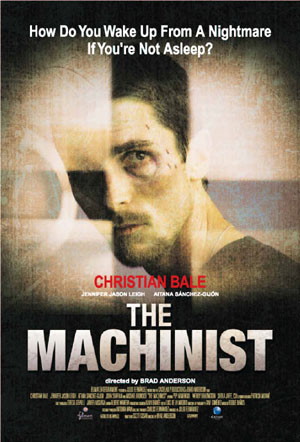
The Machinist

The title sequence of the 2005 film The Machinist Dir( Brad Anderson) follows the codes and conventions of the thriller genre. At the beginning of the sequence we see a black screen with the text of the film company but we hear the sound of a pant or someone struggling to breathe this already makes to the audience uneasy as they don't know where its coming from or who it actually is.

The soundtrack is mainly digetic in the sequence, the music is ominous and creepy which creates a thriller atmosphere. Danger is foreshadowed as there are digetic police sirens playing at the beginning of the scene.
As the audience we are watching the protagonist through a window this suggests that we are seeing it from a persons point of view, as it seems like he doesn't know that someones watching him.
Low key lightning is used throughout which creates heavy shadows also shows us the facial expression of the protaganist which makes his face look more creepy.
The sequence is overall slow paced this makes us look at whats going and pay attention to every detail

Cape Fear

The title sequence for the 1991 film Cape Fear Dir(Martin Scorsese) was designed by the graphic designer Saul Bass, he is well known for his geometric shapes and use of bold colours,
This title sequence follows the codes and conventions of thriller genre. The first scene opens on a river current with a reflection of an eagle, eagles are represented as predators and hunt by themselves for prey this suggests foreshadowing as in the film there may be a innocent be attacked by a predator.

As the sequence goes on we see an extreme close up of an eye this shot is effective because it makes the audience feel very uncomfortable. We also a silhouette of a man which hints the narrative of the film. There is a complete change of colour when we see red dipping into the water then the whole screen changes red which symbolizes danger and anger which also links back to the narrative.

The sound track is fast at first then gets slower creating a sense of panic and suspense.The music is played throughout the whole sequence. The music is very effective on creating the mood of the film as it sets a creepy and manic atmosphere.

The typography flows with the rivers current but the font is also sharp and aggressive which fits with the thriller genre.

Sunday, 27 March 2016

Forrest Gump


The 1994 film Forrest Gump dir.(Robert Zemeckis). The title sequence for this is film is about fate and where is takes us. A feather is what the camera follows as we see the feather blowing in the wind the feather is quite significant in the sequence as the feather lands at forrests feet who is the protagnist. The feather falls soft and smoothly which goes with the soundtrack which is a relaxing melody. The music sets the mood and atmosphere of the movie. We see the towns scenery through wide shots when the feather lands at Forrest feet we get medium close ups of the feather but mostly of Forrest.

Audience Profile

Journal


We researched music to go with our title sequence because our genre is thriller we are going to need a slow and eerie soundtrack to create a creepy atmosphere.
As a group we decided to add an audio to our sequence influence from the Gone Girl sequence. We choose to have one of our group member to say a few sentences from the Brothers Grimm story Hansel and Gretel as it links to our narrative of the missing boy this is effective because it adds suspense and tension towards the audience.


Filming Journal


Today we are going to start filming road signs to symbolize the protagonist journey of reopening and searching for her brother. We filmed these during school time so we had permission to go out and film. We made our way to Bexleyheath and filmed road signs such as arrows and location names. We also found a map which links to the sequence so i filmed an extreme close up of it.

Filming Journal 2


We all met at 12:00 am at the Bexleyheath clock tower then we made our way to Surpiyas house to start shooting our title sequence. We shot it in the garden shed as it was big enough to look like an attic, We shot the sequence in order to the protagonist first opening the door and making her way to the evidence box and searching through the contents.
We used different shots such as the over the shoulder, close up and medium long shot.
After shooting the scenes we moved onto shooting the montage of the protagonist replacing the old missing poster to the new one.

Friday, 25 March 2016

Thriller Codes and Conventions

Codes and Conventions of Thriller

The aim of thriller is to create suspense and excitement for the audience.
A thriller normally consists of a battle between the protagonist and antagonist, the story usually shows a chain of bad events building tension and suspense for the climax. The Thriller film often uses the busy streets and environments of is usually urban or suburban areas.

Conventions of a Thriller

Quick cuts
Low key cuts
Changes in the angle of shots
Tension music
Black and white shots
Montage of shots
Shadows
Close up shots

In Thriller the protagonist is often a brave male who seeks to restore equilibrium.
The antagonist will have a hidden identity to create mystery, but will uncover as the film carry's on.

In thriller there are a lot of close ups and extreme close ups of the protagonist, this is often to show their emotions, also it can be used to focus on the props which links to the narrative.
The shots of the antagonist will be quick shots to hide the identity, low lighting , silhouette or the shadow can also create creepiness and mystery towards the antagonist.

Music is essential to understand and set the mood of the film. In thriller it adds suspense and tension. It will usually start as a slow pace and then build up to make shots more dramatic for the audience.